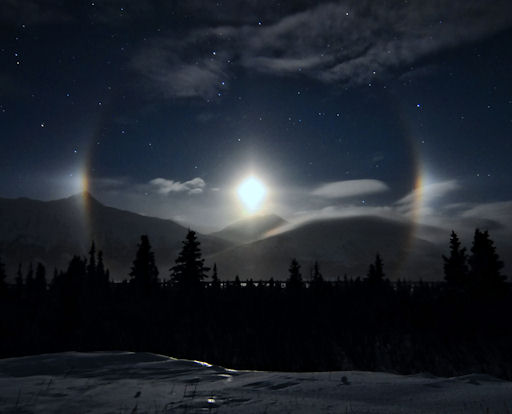
"Paraselene is the scientific name for a moondog," says Saarloos. "The phenomenon is caused by moonlight shining through ice crystals in the air." Hexagonal plate-shaped crystals, fluttering down from the clouds like leaves from trees, refract moonbeams into rainbow-colored splashes of light 22o to the right and left of the Moon, as shown above.
Moondogs are most often seen on the nights around a full Moon. That means now is the time to look. The Moon is 100% illuminated on the night of Jan. 26-27, so be alert for moondogs!


